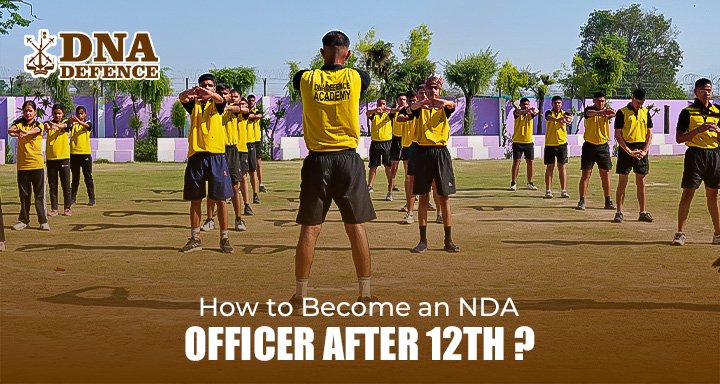
Are you looking to become an nda officer? If yes, we have got you covered. Today, we will discuss the way of becoming an nda officer. From the syllabus, eligibility, age limit, to other major factors, we will discuss everything here as we understand that it is a dream of many aspirants to serve the country as an nda officer and do something for the betterment of the nation. But due to a lack of guidance and wrong knowledge, some individuals miss their chance and fail to do so. Therefore, we have managed and mentioned the information in such a way that can help you gain the knowledge about the exam and crack it successfully. So if you are also looking to pass nda exam after 12th, then you can go through all the information mentioned in this blog. Keep reading.
NDA Exam After 12th: A Comprehensive Guide For A Successful Result
As you are looking for this exam and have a dream to clear it successfully, it is essential to have an understanding of everything related to it. Therefore, we have mentioned all the crucial details related below that you can look at and work as per the same.
Eligibility Criteria For NDA Exam
First things first, NDA officer eligibility. If you are looking to apply for it, then you must have an idea of all the requirements that are necessary to be fulfilled under the eligibility criteria. Have a look at the following details.
1. The person should be a citizen of India.
2. A subject of Nepal or Bhutan
3. A Tibetan refugee who came to indian before the 1st January 1962 with the aim of settling permanently.
4. A person of indian origin who migrated from Pakistan, Sri Lanka, Burma, East African countries (Uganda, Zambia, Zaire, Vietnam, Ethiopia, Tanzania, Kenya, or Malawi) with the aim to settle permanently in India.
5. The age of the candidate should be between 16.5 to 19.5 years.
6. The candidates should be unmarried and should remain the same till the training period.
7. Both males and females are eligible to apply.
How To Fill Out The Application Form Of the NDA Exam?
If you are looking to appear for the nda exam and want to apply for the same, then you can do so by filling out the form first. For this, have a look at the steps mentioned below and follow the process accordingly.
For One-Time Registration (OTR)
1. First, visit the upsconline.nic.in or upsc.gov.in.
2. Now, click on the new registration under one-time registration.
3. Now fill in all the essential credentials such as (name, dob, parents’ information, nationality)
4. Now, make a login ID and password and save the registration details safely.
To Fill Out the application form
1. Log in with the help of your registration ID and DOB.
2. Fill in all the sections carefully that ask for the personal information, educational details, category (st/sc/obc/female/ph), and preferences of the exam centre.
3. Now upload all the essential documents such as a passport-size photo and a signature.
4. After this, do submit the photo ID, such as aadhar/pan/voter ID/passport/driving license/school ID.
5. Now upload the documents such as class 10th and 12th certificates.
6. All the males of category general/obc are required to submit 100 rupees. SC/ST, female, and JCO/NCO/or sons are not required to submit any kind of fees.
7. You can submit the payment through debit/credit card, net banking, or SBI e-chalan.
8. Now go through all the details that you have mentioned in the form and submit carefully.
9. Now you can download or print the final confirmation page and get the payment receipt too.
What Is The Syllabus Of the NDA Exam?
This is an overview of the syllabus of nda exam that will give you an idea about the core concepts and topics of it. Have a look at all of them below.
Paper I: Mathematics (2½ hours, 120 questions, 300 marks)
You will study math at the 10+2 level in a number of important areas:
Algebra: You are required to study complex numbers, quadratic equations, sets, relations, and functions; permutations and combinations,the binomial theorem; logarithms; and sequences such as AP/GP/HP.
Learn the fundamental kinds and operations of matrices and determinants, locate adjoints and inverses, and solve linear equations using Cramer’s rule.
Trigonometry: In this, you have to focus on inverse functions, solve equations, apply height-and-distance issues, and study ratios and identities.
Examine 2D and 3D coordinate systems, equations of lines and circles, and conic sections such as parabolas, ellipses, and hyperbolas in analytical geometry.
Discuss limits, continuity, derivatives, and real-world uses such as determining maxima and minima in differential calculus.
Learn about areas under curves, definite and indefinite integrals, and fundamental ODEs in Integral Calculus & Differential Equations.
Learn how to work with 2D and 3D vectors in vector algebra, including dot and cross products.
Statistics and Probability: Determine probabilities (including Bayes’ theorem) and analyze data using the mean, median, mode, variance, and standard deviation.
General Ability Test Paper II (two and a half hours, 600 points, and 150 questions)
A. English (200 marks, around 50 questions)
This part assesses your proficiency in common English:
Grammar and usage: identifying errors and employing appropriate sentence construction.
You will be asked about vocabulary, including antonyms, synonyms, and contextual word filling.
Reading brief sentences and comprehending their major ideas is known as comprehension and flow. You are required to practice this as well.
Sentence completion and correction: This is all about enhancing readability, correcting mistakes, and arranging words logically. It is a main part of English that you need to practice.
B. General Knowledge (about 400 marks, 100 questions)
This section addresses a variety of subjects:
Physics — everything from mechanics and heat to electricity, magnetism, optics, and modern physics basics
Chemistry — core concepts like atomic structure, acids and bases, chemical reactions, and everyday chemicals.
Basics of human physiology, diet, illness, ecology, and the natural environment are covered in biology/general science.
History: an exploration of Indian cultures from antiquity to the fight for freedom
Geography: from the natural resources, climate, and structure of Earth to the geographical aspects of India.
Current Affairs: national and international events, with a focus on cultural and defense-related news
Sum Up!
This is all about the nda exam that is crucial to know in order to clear it properly. If you have any issues related to the basic details of the exam, then you can go through this blog. It has all the things that are relevant to the nda exam. If you are looking to clear the exam, then you can also connect with the DNAD, one of the best NDA coaching institutes in Dehradun. They provide the best coaching and have a great staff to cover every aspect of it. So, hope for the best and prepare well to crack it in one attempt.